Today's Runes for Hillary Clinton
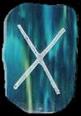
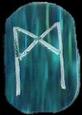
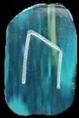
| The Fork spread is used at critical turning points, to understand the dynamics of an important decision. Jade Runes are most commonly used for questions about love, friendship, and relationships. |
| The left rune represents the first possible outcome. Gebo means gift, and like many gifts, the rune may be understood on many levels. Gifts are generally positive things, for both the giver and the recipient. In many cultures however, gifts and favors carry with them an obligation to respond in kind. It is for this reason that gifts, and hence the rune Gebo, are frequently symbolic of friendships, marriages, alliances, mergers, and other bonds between people or organizations. Gebo is a strong rune and the unions represented are strong as well. Moreover, Gebo is not reversible, as true friendships are not easily undone. |
| The right rune represents the second possible outcome. Man represents Mankind. This rune evokes the image that although we must make much of our way in the world on our own, there is nevertheless an entire populous that shares similar experiences. Thus, this rune represents the relationship of the self with the whole - working together we can produce great results. Additionally, Man speaks to intellect and culture that separate us from the animals. |
| The bottom rune represents the critical factor that determines what will come to pass. Uruz symbolizes the Auroch, a member of the ox family that became extinct long ago. This rune represents the strength, bravery, and endurance of this animal of old. Uruz portends the ability to meet problems head on and to overcome them. When the world was new, warriors used to test their strength against the Auroch. Hence, this rune has come to represent the masculine principle and the capacity to meet a challenge. |
|
|