Today's Runes for Kelsey Grammer
| The Diamond spread reveals the dynamic forces at work in a situation. It is the spread of choice for understanding a hidden conflict. Stone Runes are most commonly used for questions about the natural world and things beyond human control. |
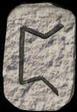
| The bottom rune represents the foundation that forms the basis of the issue. Perth is the rune of chance and gambling. Throw the dice, read your fate. Gaming is a fine way to pass the night...as long as one is careful. Games of chance have outcomes that are hidden from us, and as such Perth represents secrets unknown. Perth symbolizes enjoyment and wild abandon, but be watchful, for Perth is also the rune of mystery and the outcomes unexpected. You cannot lose if you do not play, but neither can you win... |
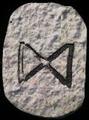
| The left rune represents one of the forces acting on the issue at hand. Dagez means daylight, and represents divine light. This rune generally refers to dawn (the initial sparking of energy) or to midday (the climax of energy). Both dawn and midday are symbolic of change, but unlike the changes in the perpetual circle of the year which are slow and subtle, the changes over a day are much faster and more dramatic. The breaking of a new day is symbolic of the rapid illumination of dismal circumstances, and is suggestive of Satori. Be careful - although this rune generally suggests a positive change, the symbology of a peaking point suggests that there must be a change downward as well. Fortunately for some, this rune is cyclic and irreversible, and so permanence is not promised - the only thing you can be sure of is an exciting ride. |
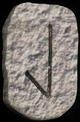
| The right rune represents another of the forces acting on the issue at hand. Laguz is the rune representing water. Laguz is a strongly feminine rune, and like the ocean contains much power of an uncontrollable nature. Here the rune is seen in the reversed, symbolic of the ebbing tide. This may suggest power being drawn away, or may perhaps the start of a journey. Since this is a rune of sexual power, the reversal can also suggest sexual problems or dissatisfaction. |
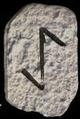
| The top rune represents the conclusion to which your strivings can carry you. Eoh refers to the Yew tree. The Yew does not go dormant and therefore represents endurance. Even the wood of the tree is strong, resilient, and pliable - the Yew bends, but does not break. The evergreen nature of the Yew is present even in the rune itself, as it cannot be changed even by reversal. This rune is historically symbolic of death, but, as in the Tarot and as suggested by the nature of the Yew tree itself, death is seen only as a transmutation of something eternal and unchanging - the spirit. |
|
|