Today's Runes for Kurt Vonnegut
| The Diamond spread reveals the dynamic forces at work in a situation. It is the spread of choice for understanding a hidden conflict. Spirit Runes are most commonly used for questions about mysticism, spirituality, and religion. |
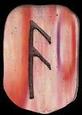
| The bottom rune represents the foundation that forms the basis of the issue. Ansuz refers to a god or the spoken word of God. It is the voice of reason, law, prophecy and truth. It is the truth heard in the wind. This rune represents wisdom obtained or knowledge delivered. It is the rune of absolute good advice and true council - the message we all must strive to hear. |
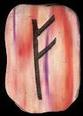
| The left rune represents one of the forces acting on the issue at hand. Fehu represents cattle the Norse symbol of wealth. This rune has some interesting implications based on the fact that cattle, unlike land, move about of their own accord. Cattle also reproduce, so this rune often speaks of wealth that renews or perpetuates itself. Wealth takes many forms, but this rune generally represents the value that is purely material or monetary in nature. Alternatively, this rune is deeply associated with Frey, and hence can be the harbinger of fertility and children. |
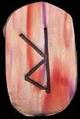
| The right rune represents another of the forces acting on the issue at hand. Raido is the rune of riding, as in a cart or as cargo. It is seen here reversed, suggesting a disruption of travel or communication. Etiological analysis of this rune has also given it interpretations of advice or justice, and of being in a position of moral correctness. Reversed, there is an indication of the lack of solid council, or the holding of a position that is not morally sound. |
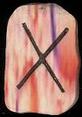
| The top rune represents the conclusion to which your strivings can carry you. Gebo means gift, and like any gifts, the rune may be understood on many levels. Gifts are generally positive things, for both the giver and the recipient. In many cultures however, gifts and favors carry with them an obligation to respond in kind. It is for this reason that gifts, and hence the rune Gebo, are frequently symbolic of friendships, marriages, alliances, mergers, and other bonds between people or organizations. Gebo is a strong rune and the unions represented are strong as well. Moreover, Gebo is not reversible, as true friendships are not easily undone. |
|
|