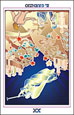
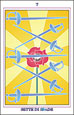
| The Celtic Cross spread is one of the most popular Tarot spreads, providing varied insight into many aspects of a complex situation and your role in it. The Voodoo Tarot of New Orleans is a deck rich in primal spirituality. It draws on images from the religion Santeria, which weaves Catholic and African beliefs into a vibrant tapestry. This exceptional deck is most often used to ask questions regarding the joy, fury, and spirituality in everyday life. If you would like your own copy of the Voodoo Tarot of New Orleans, you can buy it now! |
 | The card not shown but at the center of the cross, represents the atmosphere surrounding the central issue. Oya (Three of Discs), when reversed: Delays in the commencement of business, commercial transactions, or employment. Holding back or failing to use one's abilities to their full potential. Shoddy workmanship and lack of attention to detail. Being hamstrung by convention, or failing to temper artistic fancy with an understanding of reality. |
 | The card visible at the center of the cross represents the obstacle that stands in your way - it may even be something that sounds good but is not actually to your benefit. Gros Bon Ange (The Sun), when reversed: Loneliness and uncertainty. Nostalgic memories. The warm passing glow of dusk. Peace without vigilance. |
 | The card at the top of the cross represents your goal, or the best you can achieve without a dramatic change of priorities. Obatala (Four of Discs), when reversed: Using your power freely for your own enjoyment and the betterment of others. Coming to grips with progress and using your position to help it along. Finding security and identity someplace other than in the possession of material things. Letting go and encouraging others to find their own path. Being magnanimous and generous with your success. |
 | The card at the bottom of the cross represents the foundation on which the situation is based. Rada Houngan (King of Swords): The essence of air, such as a clear blue sky: A mature leader of unwavering ethics and indisputable authority. An incorruptible judge, whose devotion to the law cannot be swayed by emotion or material concerns. Perfect clarity of thought, directness of action, and eloquence of speech. One who, like a great general, inspires not love or devotion, but absolute trust and loyalty. |
 | The card at the left of the cross represents a passing influence or something to be released. Carnival (The World), when reversed: Incompleteness and shoddy design. A great work betrayed. Insecurity, fear of change, and the failure to reach goals. Regret and disappointment. |
 | The card at the right of the cross represents an approaching influence or something to be embraced. Azaka (Ten of Swords): Crushing defeat brought about by idle intellectualism divorced from reality. Sadness and desolation in the aftermath of a catastrophic and total collapse. A decisive conclusion brought about through the swift and merciless application of overwhelming force. |
 | The card at the base of the staff represents your role or attitude. Eleggua (Six of Discs): A time of prosperity and profit. Success and generosity in material things. Power and influence turned to noble pursuits. Philanthropy, and the balancing of physical and spiritual life. May suggest gifts or aid to one in need. |
 | The card second from the bottom of the staff represents your environment and the people you are interacting with. Petro La Place (Knight of Wands): The essence of fire, such a great conflagration. One filled with vitality and passion for life. A sexy and exciting person, daring in their actions, cocky in their attitude, and utterly without fear. Absolute sincerity, coupled with violent emotions that swing wildly from one extreme to another. Boundless creativity and lust for a change of both pace and place. The rapid approach, or more likely departure, of something that sets your world ablaze. Often suggests travel or escape. |
 | The card second from the top of the staff represents your hopes, fears, or an unexpected element that will come into play. Madame La Lune (Nine of Cups): Contentment and satisfaction in romance, friendship, or other relationships. Achieving your deepest desires and savoring beauty and sensual pleasures. A state of joy and abundance radiating fulfillment and bliss. |
 | The card at the top of the staff represents the ultimate outcome should you continue on this course. Legba La Flambeau (Six of Wands), when reversed: Arrogance and dangerous overconfidence as the result of a past success. Impudence and false pride in meaningless achievements. Fear of failure coupled with false hopes. Frustration over indefinite delays and motion without progress. |