Today's Tarot for Chuck Norris
| The Fourfold Vision spread offers a progression of different ways of looking at an object, person, or situation. It is a powerful tool for gaining deeper insight into the specific subjects of other readings. The Ator Tarot is a smart and whimsical spin on Rider Waite symbolism. The clunky and adorable characters of the Ator Tarot make it the deck of choice for those seeking a refreshing approach to divination. If you would like your own copy of the Ator Tarot, you can buy it now! |
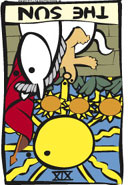 | The card on the far right represents the object being viewed, be it an idea, relationship, or the self. The Sun, when reversed: Loneliness and uncertainty. Nostalgic memories. The warm passing glow of dusk. Peace without vigilance. |
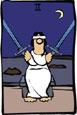
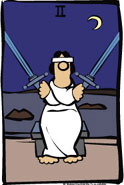 | The card second from the right represents the physical vision: how the object is seen at a base or mechanical level. Two of Swords (Peace): Contradictory characteristics brought together as a means of resolving a conflict. Refusing to be ruled by negative emotions. Strife brought to a close through clarity of mind and restraint of force. Turning a blind eye to the minor infractions of others. |
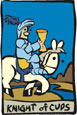
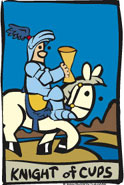 | The card in the middle represents the mental vision: the object personified and seen through a humanized perspective. Knight of Cups: The essence of water behaving as fire, such as a rushing river: A passionate romantic, full of charm and beauty, but prone to extremes. Forceful idealism blended with gentle kindness. An eager and intense person, forward with their emotions and tender in their support of others. |
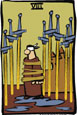
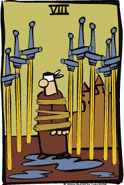 | The card second from the left represents the emotional vision: how passions and values are creatively stimulated by the mental vision. Eight of Swords (Interference): Chagrin at the unforeseen consequences of prior decisions. Criticism, censure, and the imposition of external restrictions. Confusion leading to powerlessness. Inability to focus on the crux of a problem and free oneself from a difficult situation. Being hamstrung by a past failure or humiliation. |
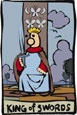
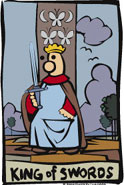 | The card on the far left represents the fourfold or mystical vision: still viewing through the previous three, we now add a spiritual element, revealing unseen aspects of the object. King of Swords: The essence of air, such as a clear blue sky: A mature leader of unwavering ethics and indisputable authority. An incorruptible judge, whose devotion to the law cannot be swayed by emotion or material concerns. Perfect clarity of thought, directness of action, and eloquence of speech. One who, like a great general, inspires not love or devotion, but absolute trust and loyalty. |
|
|