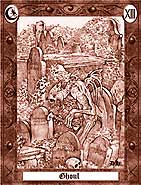
| The Relationship spread provides insight into the interaction between two people or entities. It is the spread of choice for questions about partnerships, be they in romance or business. The William Blake Tarot explores the mystical vision and artistry of the renowned English painter and poet. Through rich interpretations focused on creative undertakings, it has long been the deck of choice for artists, writers, musicians, and thinkers. For more information about this deck, or to buy your own personal copy, go to www.blaketarot.com.
|
 | The card at the top left represents how you see yourself. Moon, when reversed: Encountering unconscious fears. Possible self-deceptions and distortions of reality. Lunatic urges, including sexual license. Keeping secrets. Hidden conditions and unknown circumstances. Cyclic patterns and influences. |
 | The card at the top right represents how you see your partner. Six of Painting (Assistance): Giving or receiving favors or tangible help of some kind. Sponsorship or patronage. A positive influence in the situation. Although "over your head," an angel may rescue you. Generosity of spirit. Being charitable. Assisting those in need. In the creative process: You can attract the assistance and tools you need by using your imagination and not giving up hope. |
 | The card in the center left represents how you feel about your partner. Five of Poetry (Strife), when reversed: Personal illumination amidst conflict. Defeating inner demons and freeing oneself from disillusionment. Refusing to be drawn into competition, arguments, and power struggles. A time to question authority. In the creative process: This points to a stressful time battling inner doubts and outer difficulties; you can improve your project or product by getting to the truth of the matter. |
 | The card in the center right represents what stands between you and your partner. Liberty, when reversed: Restriction of personal freedom. A call to action goes unheard. Failure to reach a deeper level of awareness or sense of spiritual self. Failure to effect a basic change of state. Refusal to make an important decision or judgment, perhaps one long delayed. Being bound by limiting circumstances. |
 | The card in the lower left represents how your partner sees you. Eight of Painting (Discipline), when reversed: Mismanagement of your workload or time. Failing to get a grip on the situation. Refusal to listen to a mentor or inner guide. A need for physical assessment and self-improvement. Seek appropriate education and training. Inability to take one step at a time. Lack of due diligence. Collapsing under a mountain of work. In the creative process: Even though you may have a long way to go, a methodical approach incorporating guidance and training will ultimately lead you to the top. |
 | The card in the lower right represents what your partner feels about you. Eight of Science (Restriction), when reversed: Suppressed creative energy waiting to burst free. External constraints provide much-needed focus. Intense mental fervor despite outward calm. Freedom from your prejudices, dogmatic attitudes, and fear of failure. Self discipline and mastery over ones emotions. In the creative process: Make your obstructions or limitations productive by stimulating greater intensity of thought and a deeper sense of spiritual freedom. |
 | The card in the center represents the present status or challenge of the relationship. Three of Painting (Practice): A need to exercise and master your skills and talents. Creatively interacting with your peers. The play of social dynamics at work or on the job. Seeking a synthesis of the available factors. Building support. Integrating energies to achieve a mutual goal. In the creative process: Experimentation and manipulation are the keys to acquiring the experience needed to get the job done. |