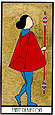
Today's Tarot for Kylie Minogue
| The Cross and Triangle spread is a powerful means of understanding complex situations, developed by the Hermetic Order of the Golden Dawn. This spread is rich in occult and mystical symbolism, and one of our favorites here at Facade. The Benedetti Tarot is a highly stylized deck painted on gold leaf. 7 years in the making, the images were inspired by the Visconti Tarot, the earliest Tarot deck still in existence. The Benedetti Tarot is the favorite deck of those who seek simplicity and elegance in their lives. |
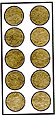
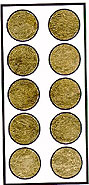 | The first card, the significator, is placed in the center of the cross. This card represents the prime energy manifest in your life. Ten of Pentacles (Wealth), when reversed: Material prosperity and riches squandered through slothfulness, gambling, or family problems. The loss of reputation or inheritance, or the failure to pass an inheritance along to one's children. |
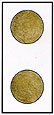
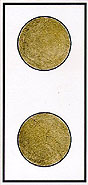 | The second card, placed above the significator, represents Air. It describes your spirit, process of thought, and the influence of reason. Two of Pentacles (Change), when reversed: Imbalance and disharmony as a result of upheaval and transformation. Taking one step forward for every two steps back. Chaos caused by the shifting importance of projects and priorities. Industrious yet unreliable actions. Furious activity producing negligible results. |
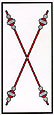
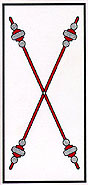 | The third card, placed to the right of the significator, represents Fire. It describes your motivations, creative energies, and the influence of passion. Two of Wands (Dominion), when reversed: The erosion of power and influence. Failing to articulate goals or establish a vision for the future. Being caught off guard, due to an inability to come to grips with the impact of past decisions. Obstinate and irresponsible leadership. Loss of interest, clarity, or faith in a venture. |
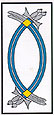
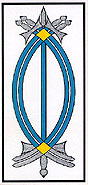 | The fourth card, placed below the significator, represents Water. It describes your emotions, meditations, and the influence of love. Five of Swords (Defeat): A success earned through personal degradation. Separation from friends brought about by an unfeeling and coldly calculated act. Temporary victory tainted by dishonor and providing fuel for eventual defeat. |
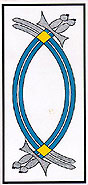 | The fifth card, placed to the left of the significator represents Earth. It describes your physical presence, position in life, and the influence of the material world. Four of Swords (Truce), when reversed: Restlessness and mental disharmony. Deserting a struggle in progress. A temporary retreat from stress that turns into a permanent rout. A lack of vigilance that could lead to disaster. |
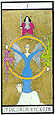
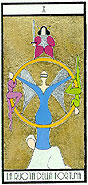 | At this point the cross is complete and the triangle is formed. The sixth card, placed on the bottom left of the triangle represents one of two opposing forces. Wheel of Fortune: The path of destiny. Karma on a grand scale. An unexpected turn of good fortune. A link in the chain of events. Success, luck, and happiness. |
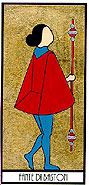 | The seventh card, placed on the bottom right of the triangle represents the force that opposes the bottom left card. These forces may be external, but they are frequently one's own inner archetypes in conflict. Page of Wands: The essence of fire behaving as earth, such as wood or coal: The surprising appearance of a new passion. An adventurer who blazes through life, acting as a catalyst that others may harness. The intense enthusiasm and childlike imagination that fuels any new venture, needing only the application of mind and material to make it a success. Inner fire that can drive away fear and replace it with fury. Can represent a person of some timidity, but whose innate passion can be easily ignited. May indicate the birth of a child. |
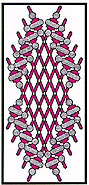 | The eighth card, the reconciler, is placed below the cross in the third vertex of the triangle. This is the force that will resolve the conflict between the bottom left and bottom right cards. By meditating on this force and bringing more of it into your life, you can bring the matter at hand to a swifter conclusion than would naturally occur. Ten of Wands (Oppression): Success and gain, leading you to take on a burden greater than you can carry. Noble leadership transformed, through lack of restraint, into tyranny. The crushing weight of ultimate responsibility. Having spent their fuel, the engines of creation grind to a halt. |
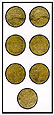
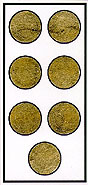 | The ninth and final card, placed in the center bottom of the triangle, represents the final outcome unless you change course. Seven of Pentacles (Assessment), when reversed: Labors abandoned before completion. Impatience, lack of effort, and the wasting of time. Idle and unprofitable speculation. |
|
|