| The Twisting Path spread provides insight into the path ahead of you and the choices you must make. This is the spread for situations where more than one pitfall may lie ahead. The Marseilles Tarot is an 18th century creation of obscure origins. It predates the occult symbolism of the Rider Waite deck by roughly 200 years, giving the readings a unique and rustic flavor. Many swear by this deck as the true oracle of the common man. If you would like your own copy of the Marseilles Tarot, you can buy it now! |
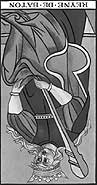 | The card at the lower left, represents the first decision along your path. Reyne de Baton (Queen of Batons), when reversed: The dark essence of fire behaving as water, such as steam: The natural embodiment of passion and sensuality, who will do anything to the be the center of attention. A seducer who calculatingly dons the guise of what others desire. A cocky and domineering person, who pushes anyone or anything aside to get what she wants. One who is vengeful and quick to take offense without good cause. May indicate infidelity and contempt for a relationship. |
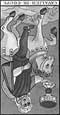
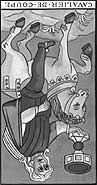 | The card to the far left represents the first false path that may lead you astray. Cavalier de Coupe (Knight of Cups), when reversed: The dark essence of water behaving as fire, such as a flash flood: Deceptive charm in the service of intense insecurity and rapidly shifting moods. Selfishness, indolence, and a complete lack of maturity. Misguided idealism divorced from practicality. Destructive romantic passions and infidelity. |
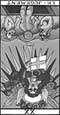
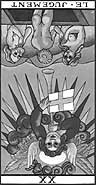 | The card in the middle represents the second decision along your path. Le Jugement (Judgement), when reversed: Procrastination and indecision. Disillusionment and the inability bring a matter to conclusion. |
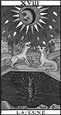
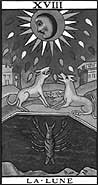 | The card at the lower right represents the second false path that may lead you astray. La Lune (The Moon): Cyclic transformation covering the mysterious forces of the night. Feminine beauty and the intoxicating vitality of youth. The metamorphosis from beauty to beast and vice versa. Occult forces, sensitivities and intense dreams. Dangerous situations and perilous times. |
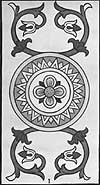 | The card at the top represents one possible mask of your true destination. Ace of Coins: The seed of prosperity and material gain - perhaps as yet unseen. A new foundation from which to turn your dreams into reality. The need to focus on the practical and understand the dynamics of the natural world. May represent a gift, document, inheritance, or an unexpected opportunity for physical achievement. |