Today's Runes for Dean Martin
| The Diamond spread reveals the dynamic forces at work in a situation. It is the spread of choice for understanding a hidden conflict. Jade Runes are most commonly used for questions about love, friendship, and relationships. |
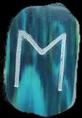
| The bottom rune represents the foundation that forms the basis of the issue. Ehwaz is the rune of the eight-legged horse that the god Odin rode into battle. Horses are symbolic of a number of things. Firstly, horses may symbolize vehicles such as cars, motorcycles, planes, or boats. Secondly, horses may symbolize not wealth, but status. Thirdly, horses may symbolize motion towards an objective. As such, this rune suggests a journey or a quest to achieve a goal or improve one's station in life. On a deeper level, the rune Ehwaz evokes the unique relationship of horse and rider as an inseparable team. To the modern eye this may be the relationship of master and underling, but to the Norse it was a total union. In fact, early representations of Odin are not of a man and a horse, but, of a centaur-like creature - the ultimate symbiosis of Man and Nature. |
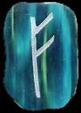
| The left rune represents one of the forces acting on the issue at hand. Fehu represents cattle the Norse symbol of wealth. This rune has some interesting implications based on the fact that cattle, unlike land, move about of their own accord. Cattle also reproduce, so this rune often speaks of wealth that renews or perpetuates itself. Wealth takes many forms, but this rune generally represents the value that is purely material or monetary in nature. Alternatively, this rune is deeply associated with Frey, and hence can be the harbinger of fertility and children. |
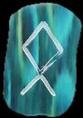
| The right rune represents another of the forces acting on the issue at hand. Othila is the homeland. Land was the purest form of immovable wealth in Norse civilization, distinct from the movable wealth represented by Fehu. This rune speaks of stability and safety stemming from inheritance, both material and genetic. With respect to the question asked, consider the background of the people and families involved... |
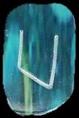
| The top rune represents the conclusion to which your strivings can carry you. Uruz is the name of the Auroch, an extinct prehistoric ox. This animal was strong and brave, and was the focus of rites of manhood in older days. Reversed, this rune symbolizes either the lack of challenge, or the lack of preparation for a challenge. This rune suggests that you must reach deep within in order to gain the power you will need, whether to get out of your current rut, or to face what appears to be a hopeless situation. |
|
|