Today's Runes for Pamela Anderson
| The Cross spread is used to plot the arc of your life and the forces acting on it. It is the most popular spread, giving a very complete view of the situation. Spirit Runes are most commonly used for questions about mysticism, spirituality, and religion. |
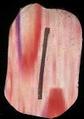
| The left rune represents an important element of the past. Isa is the rune symbolizing Ice - cold, stagnant, frozen, and unchanging. This rune suggests heat removed not just from anger or conflict, but from passion as well. Paradoxically, Isa conveys images of slippery slopes and unsure footing, but also of circumstances that have crystallized and become utterly immutable. Remember that in the cold north, ice is not just THE challenge to be overcome, but the very nature of the environment. Be courageous, for you work against this element every day. Will you fight alone or with others against this, our common foe? Is there much worse than lack of change? |
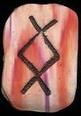
| The middle rune represents a deciding element of the present. Inguz is the rune of completion and fertility. The presence of this rune suggests that tasks which have been initiated will come to fruition. This rune is associated with Ing and Frey, it is this connection that explains its connotations of both fertility and sexuality. The variant of this rune shown here is reminiscent of the twin strands of life, and of the challenge and rewards of bringing together things complimentary. |
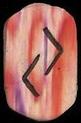
| The top rune represents a force that works for you. Ger is one of the runes that touches on the cycles of the year, in this case the fall harvest. These cycles are eternal, which is represented in the rune by the fact that it is unchanged by reversal. Ger can represent pregnancy or other forms of fruitfulness, and is especially indicative of the cycles of providence and karma - that which has been sown is now being reaped. This rune can also represent the cycles of wealth, for crops were frequently a sign of wealth. |
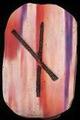
| The bottom Rune represents a force that works against you. Nyd is frequently seen as a powerfully negative rune. You have drawn the rune reversed, which will lessen some of its effects. Generally Nyd represents loss, sorrow, and a hard journey with lessons learned. Nyd reversed here might be cautioning that the lessons might go unheeded representing repeated mistakes. The rune here might also be representing a minor loss or a nearly avoided catastrophe. Be careful, things are tricky and require strong attentiveness. |
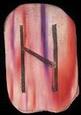
| The right rune represents the critical element of the future, at the core of the final outcome. Hagalaz is the rune of hail. Hail is a destructive and elemental force, so one can expect this rune to represent the disruption of one's life. In the harsh northern winter there is a halt to activity, and so delay or hindrance is frequently associated with this rune. The opposite of chaos is yet more chaos, as illustrated by the fact that this rune cannot be reversed. |
|
|