Today's Runes for Ronald Reagan
| The Diamond spread reveals the dynamic forces at work in a situation. It is the spread of choice for understanding a hidden conflict. Gold Runes are most commonly used for questions about business, career, and property. |
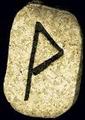
| The bottom rune represents the foundation that forms the basis of the issue. Wunjo is the rune of Joy. Since joy is least frequently a solitary emotion, this rune often represents mutual or communal bliss. Wunjo is also seen as a rune of the gods and a rune of perfection, carrying with it the elation that blazes from the creation of a perfect work - perhaps this is the true joy of the gods, that they can create perfection. That aside, this rune does not focus on the struggle for perfection or on our inevitable imperfections, but rather on a job well done and the satisfaction that comes from it. |
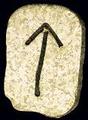
| The left rune represents one of the forces acting on the issue at hand. Tyr is the symbol of the warrior. This rune most represents masculine force and potency, and frequently victory in battle. Beware though, for this rune represents directly the Norse god whose name it bears - Tyr stands out in legend for having sacrificed his hand that he might bind Fenrir, a monstrous wolf that threatens to swallow the world. As such, this rune is known to portend a great victory that can be bought with a terrible sacrifice. Tyr is also the god of law, frequently placed in such position above Odin. In this aspect, protection of justice may be had by this rune. |
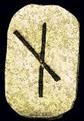
| The right rune represents another of the forces acting on the issue at hand. Nyd is frequently seen as a powerfully negative rune. You have drawn the rune reversed, which will lessen some of its effects. Generally Nyd represents loss, sorrow, and a hard journey with lessons learned. Nyd reversed here might be cautioning that the lessons might go unheeded representing repeated mistakes. The rune here might also be representing a minor loss or a nearly avoided catastrophe. Be careful, things are tricky and require strong attentiveness. |
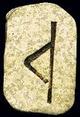
| The top rune represents the conclusion to which your strivings can carry you. Thurisaz the thorn represents barriers and senseless violence. Here we see the thorn overturned. This could mean that erected barriers will not hold, or that senseless violence can be avoided. Also, remember where thorns are found - perhaps this rune portends that a goal can be obtained easily and without interference. Grasp for the rose... |
|
|