Today's Tarot for Benito Juarez
| The Fourfold Vision spread offers a progression of different ways of looking at an object, person, or situation. It is a powerful tool for gaining deeper insight into the specific subjects of other readings. The Voodoo Tarot of New Orleans is a deck rich in primal spirituality. It draws on images from the religion Santeria, which weaves Catholic and African beliefs into a vibrant tapestry. This exceptional deck is most often used to ask questions regarding the joy, fury, and spirituality in everyday life. If you would like your own copy of the Voodoo Tarot of New Orleans, you can buy it now! |
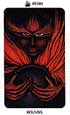
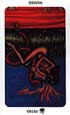
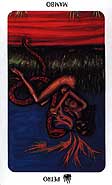 | The card on the far right represents the object being viewed, be it an idea, relationship, or the self. Petro Mambo (Queen of Wands), when reversed: The dark essence of fire behaving as water, such as steam: The natural embodiment of passion and sensuality, who will do anything to the be the center of attention. A seducer who calculatingly dons the guise of what others desire. A cocky and domineering person, who pushes anyone or anything aside to get what she wants. One who is vengeful and quick to take offense without good cause. May indicate infidelity and contempt for a relationship. |
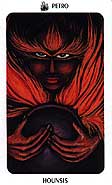 | The card second from the right represents the physical vision: how the object is seen at a base or mechanical level. Petro Hounsis (Page of Wands): The essence of fire behaving as earth, such as wood or coal: The surprising appearance of a new passion. An adventurer who blazes through life, acting as a catalyst that others may harness. The intense enthusiasm and childlike imagination that fuels any new venture, needing only the application of mind and material to make it a success. Inner fire that can drive away fear and replace it with fury. Can represent a person of some timidity, but whose innate passion can be easily ignited. May indicate the birth of a child. |
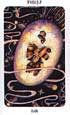
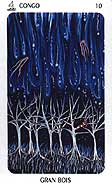 | The card in the middle represents the mental vision: the object personified and seen through a humanized perspective. Gran Bois (Ten of Cups): Fulfillment and joy in life and love. Feeling peace, tranquility, and contentment in friends and family. Taking delight in one's good fortune. |
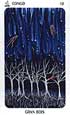
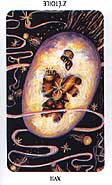 | The card second from the left represents the emotional vision: how passions and values are creatively stimulated by the mental vision. Z'Etoile (The Star), when reversed: Lost hopes, doubt and failure. Physical health and mental outlook lost in the outer darkness. Desperation leading to blind faith in false solutions. |
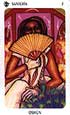
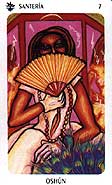 | The card on the far left represents the fourfold or mystical vision: still viewing through the previous three, we now add a spiritual element, revealing unseen aspects of the object. Oshun (Seven of Discs): A pause to check on the progress of your labors. Making difficult financial decisions. Exercising patience and perseverance. Evaluating the status of your work and your options for the future. |
|
|