Today's Tarot for Douglas MacArthur
| The Cross and Triangle spread is a powerful means of understanding complex situations, developed by the Hermetic Order of the Golden Dawn. This spread is rich in occult and mystical symbolism, and one of our favorites here at Facade. The images of the Minchiate Tarot are drawn from a rare surviving 18th century deck of 97 cards - 19 more than the traditional Tarot. It is considered by many to be the single most powerful divination tool on the web, providing deep insight, rich in ancient symbolism, to any question you may pose. If you would like your own copy of the Minchiate Tarot, you can buy it now!
|
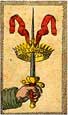
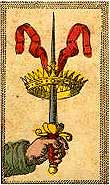 | The first card, the significator, is placed in the center of the cross. This card represents the prime energy manifest in your life. Ace of Swords: The seed of victory - perhaps as yet unseen. A challenge to be met and solved through the invocation of force. An opportunity to bring reason and intelligence to bear in the pursuit of justice and truth. An excessive power that must not be abused. May suggest new ideas or information that can reveal a solution to the problem at hand. |
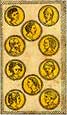
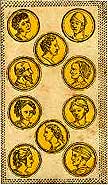 | The second card, placed above the significator, represents Air. It describes your spirit, process of thought, and the influence of reason. Ten of Coins (Wealth): Completion of material prosperity and riches. Freedom from financial anxiety, the security of home, and the enjoyment of family. The passing of inheritance along to children, or the gaining of inheritance from parents. |
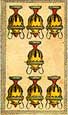
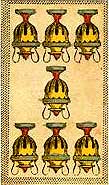 | The third card, placed to the right of the significator, represents Fire. It describes your motivations, creative energies, and the influence of passion. Seven of Cups (Temptation), when reversed: Daydreams and fantasies brought into realistic focus. The contemplation of many options leading to a conclusive choice. Inner clarity that dissipates illusions and false choices. Remaining connected to reality in the face of intoxication, delirium, or hallucination. Under rare and extreme circumstances, may indicate the failure to recognize a transcendental spiritual truth. |
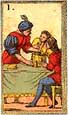
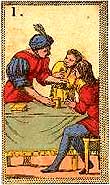 | The fourth card, placed below the significator, represents Water. It describes your emotions, meditations, and the influence of love. The Magician: Mastery over word, mind, and matter. The ability to turn ideas into actions, handle problems, and control one's life. The initiation of new projects, great works, or a new way of life. Eloquent and moving communication. Arcane and eldritch technologies. |
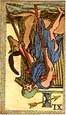
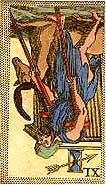 | The fifth card, placed to the left of the significator represents Earth. It describes your physical presence, position in life, and the influence of the material world. Time, when reversed: The great equalizer - the great are brought low and the petty are elevated. Obsession with the passage of time and the immanence of death. Being overwhelmed by the repetition of evil and mediocrity, and withdrawing from the world. Cynicism and nihilism driven by regret over past mistakes. |
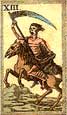
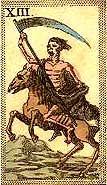 | At this point the cross is complete and the triangle is formed. The sixth card, placed on the bottom left of the triangle represents one of two opposing forces. Death: A major change or transformation, possibly traumatic and unexpected. Freedom from the shackles of the past. A new beginning. Death coupled with rebirth, usually related to consciousness and lifestyle. |
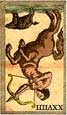
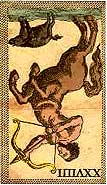 | The seventh card, placed on the bottom right of the triangle represents the force that opposes the bottom left card. These forces may be external, but they are frequently one's own inner archetypes in conflict. Sagittarius, when reversed: Blind optimism and carelessness. Inability to set a goal and follow it. General irresponsibility and lack of attention paid to anything beyond the superficial. Tactless and abrasive communication. |
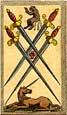
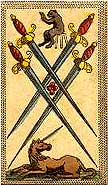 | The eighth card, the reconciler, is placed below the cross in the third vertex of the triangle. This is the force that will resolve the conflict between the bottom left and bottom right cards. By meditating on this force and bringing more of it into your life, you can bring the matter at hand to a swifter conclusion than would naturally occur. Four of Swords (Truce): A time of tranquility and intellectual repose in the midst of a great struggle. A temporary retreat from stress to regather inner strength, reaffirm convictions, reorganize thoughts, and formulate a new plan. The need for vigilance in a moment of calm. May suggest a withdrawal from the material world to find spiritual guidance. |
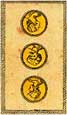
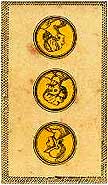 | The ninth and final card, placed in the center bottom of the triangle, represents the final outcome unless you change course. Three of Coins (Works), when reversed: Delays in the commencement of business, commercial transactions, or employment. Holding back or failing to use one's abilities to their full potential. Shoddy workmanship and lack of attention to detail. Being hamstrung by convention, or failing to temper artistic fancy with an understanding of reality. |
|
|