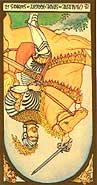
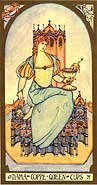
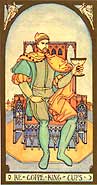
| The Celtic Cross spread is one of the most popular Tarot spreads, providing varied insight into many aspects of a complex situation and your role in it. The William Blake Tarot explores the mystical vision and artistry of the renowned English painter and poet. Through rich interpretations focused on creative undertakings, it has long been the deck of choice for artists, writers, musicians, and thinkers. For more information about this deck, or to buy your own personal copy, go to www.blaketarot.com.
|
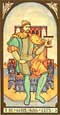
 | The card not shown but at the center of the cross, represents the atmosphere surrounding the central issue. Child of Painting: Riding the wave of prosperity. A time to show your hand and reveal your innate powers. Enjoying a position of material advantage. Putting forth charisma. Hedonistic enjoyment. Drug experimentation. Surfing the Internet. Total absorption in your activities. Trusting your body and instincts. Open to new experiences. In the creative process: Now is a time to experiment with processes and materials, taking great pleasure in what you learn and create. |
 | The card visible at the center of the cross represents the obstacle that stands in your way - it may even be something that sounds good but is not actually to your benefit. Five of Poetry (Strife), when reversed: Personal illumination amidst conflict. Defeating inner demons and freeing oneself from disillusionment. Refusing to be drawn into competition, arguments, and power struggles. A time to question authority. In the creative process: This points to a stressful time battling inner doubts and outer difficulties; you can improve your project or product by getting to the truth of the matter. |
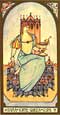
 | The card at the top of the cross represents your goal, or the best you can achieve without a dramatic change of priorities. Reason: Using your head to get through a situation. A time to define or obey the rules. Yielding to or being the boss, or authority figure. Patriarchal or traditional approach is favored. Fathering issues. |
 | The card at the bottom of the cross represents the foundation on which the situation is based. Eight of Music (Discontent), when reversed: Freedom from disappointment and dissatisfaction. The release of repressed emotions and distress. Being unphased by circumstances. Emotional stability in the face of challenge. Serenity. In the creative process: Psychodrama and emotional torments can serve as imaginative stimulants. Expressing and documenting what you feel can be artful as well as healing. |
 | The card at the left of the cross represents a passing influence or something to be released. Two of Music (Contraries): "Without Contraries is no progression. Attraction and Repulsion, Reason and Energy, Love and Hate, are necessary to Human existence". A paradoxical situation at hand. Being faced with emotional choices. Different kinds of energies needing to be harmonized. Attraction of opposites. Focus on strengthening friendship and partnership. Transcending differences. Exchanges for mutual benefit. Being willing to meet someone halfway. In the creative process: Use the presence of contrary elements as an impetus for unleashing your imagination to exploit the inherent possibilities. |
 | The card at the right of the cross represents an approaching influence or something to be embraced. Religion, when reversed: Hypocritical influences and spiritual materialism. Corruption in high places. Fighting or giving in to City Hall. Feeling oppressed by the rules. Question authority and be suspicious of leaders and gurus. |
 | The card at the base of the staff represents your role or attitude. Three of Music (Exuberance): "Exuberance is Beauty". Sense of emotional expansion. Something that makes you sing for joy. Intense desire for creative expression. A cause for lively celebration. Plunging into creative new territory. Getting people excited about your idea. Supportive alliances or relationships. Entertaining gatherings, performances, meetings, get-togethers. In the creative process: Exciting and joyous progress is taking place; blow your horn! |
 | The card second from the bottom of the staff represents your environment and the people you are interacting with. Four of Music (Musing): "And I wrote my happy songs / Every child may joy to hear". Being at peace with yourself. Taking the time to reminisce and let your mind wander. Relief from emotional stress. Combining business with pleasure. Focus on playful communication. Mulling things over. Relaxed and slow pace. In the creative process: Relax into playfulness, whimsically experiment with improvisation or reminiscence about past experiences. Such meditations alleviate stress and refresh the imagination. Make space for the gifts of spirit to move through you. |
 | The card second from the top of the staff represents your hopes, fears, or an unexpected element that will come into play. Three of Painting (Practice), when reversed: Failure to master your skills and talents. Lack of engagement with your peers. Unwillingness to synthesize the available factors. Failure to build support. In the creative process: Experimentation and manipulation are the keys to acquiring the experience needed to get the job done. |
 | The card at the top of the staff represents the ultimate outcome should you continue on this course. Seven of Music (Fancies): "To Me This World is all One continued Vision of Fancy or Imagination". Inspired by a range of opportunities and ideas. Expressive challenges involving dreams and daydreams, or altered states of consciousness. Challenges of immediate versus long-term gratification. In the creative process: Let your visions and dreams lead the way into deeper realms of your imagination, and be prepared to express them. Rehearse and explore wild ideas in your mind before acting on them. |