| The Celtic Cross spread is one of the most popular Tarot spreads, providing varied insight into many aspects of a complex situation and your role in it. The Voodoo Tarot of New Orleans is a deck rich in primal spirituality. It draws on images from the religion Santeria, which weaves Catholic and African beliefs into a vibrant tapestry. This exceptional deck is most often used to ask questions regarding the joy, fury, and spirituality in everyday life. If you would like your own copy of the Voodoo Tarot of New Orleans, you can buy it now! |
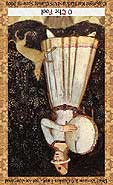
 | The card not shown but at the center of the cross, represents the atmosphere surrounding the central issue. Congo Houngan (King of Cups), when reversed: The dark essence of water behaving as air, such as rain clouds in a gray sky: A pillar of maturity and patience, hiding a deep insecurity and an indecisive nature. One who secretly lusts for power, but lacks the courage, intellect, or work ethic necessary to take it. A charming seducer who appears innocent and understanding, but is in fact selfish and unfaithful. |
 | The card visible at the center of the cross represents the obstacle that stands in your way - it may even be something that sounds good but is not actually to your benefit. Nan Nan Bouclou La Flambeau (Two of Wands), when reversed: The erosion of power and influence. Failing to articulate goals or establish a vision for the future. Being caught off guard, due to an inability to come to grips with the impact of past decisions. Obstinate and irresponsible leadership. Loss of interest, clarity, or faith in a venture. |
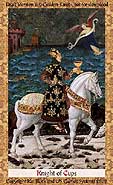
 | The card at the top of the cross represents your goal, or the best you can achieve without a dramatic change of priorities. Congo La Place (Knight of Cups): The essence of water behaving as fire, such as a rushing river: A passionate romantic, full of charm and beauty, but prone to extremes. Forceful idealism blended with gentle kindness. An eager and intense person, forward with their emotions and tender in their support of others. |
 | The card at the bottom of the cross represents the foundation on which the situation is based. The World Egg (The Fool), when reversed: Apathy, negligence, and dangerous carelessness. Unquenchable wanderlust. Obsession with someone or something. Losing all sense of proportion. Foolhardy adventuring and lack of interest in critical matters. Immature or unrealistic ideals. Strange impulses and desires coming from unexpected sources. Vanity, delirium, folly, and oblivion. |
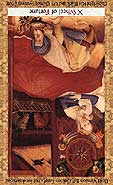
 | The card at the left of the cross represents a passing influence or something to be released. The Market (The Wheel), when reversed: An unexpected turn of bad luck. A broken sequence of events. Outside influences for the worse. An inescapable descent due to Fate or Karma. Great changes taking place as a result of earlier actions that cannot be taken back. Misfortune, failure and reluctance to use free will. |
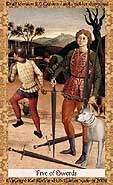
 | The card at the right of the cross represents an approaching influence or something to be embraced. Guedeh La Flambeau (Three of Wands): Personal fortitude and strength of character. Accumulated power set in motion towards a distant goal. The initiation of an enduring partnership based on absolute trust. Honor maintained in a time of desperate struggle. Taking full responsibility for a decision, and bearing the solitude of leadership. |
 | The card at the base of the staff represents your role or attitude. Azaka (Ten of Swords): Crushing defeat brought about by idle intellectualism divorced from reality. Sadness and desolation in the aftermath of a catastrophic and total collapse. A decisive conclusion brought about through the swift and merciless application of overwhelming force. |
 | The card second from the bottom of the staff represents your environment and the people you are interacting with. Shi-Li-Bo Nouvavou and Dan-I (Six of Cups), when reversed: Closing your heart to the simple pleasures of life. Escaping realities by living in the past. Refusal to grow up and embrace the joys of adulthood. Contempt for acts of gentle kindness. May indicate immaturity or sexual insecurities. May indicate the departure of an old friend. |
 | The card second from the top of the staff represents your hopes, fears, or an unexpected element that will come into play. Ogoun La Flambeau (Five of Wands): An intense struggle motivated purely by the love of competition. A state of seeming chaos driven by endless small disputes and complications. A hotly contested race, debate, game, or other challenge. A stressful situation that brings out the best in the participants. |
 | The card at the top of the staff represents the ultimate outcome should you continue on this course. Yemaya (Nine of Discs), when reversed: Bad luck attending material affairs. Elitism and snobbishness. Lack of discipline resulting in the erosion of security and stability. Contempt for the exact labors that brought one to a position of refinement. Dishonesty in financial matters. |