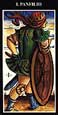
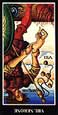
| The Relationship spread provides insight into the interaction between two people or entities. It is the spread of choice for questions about partnerships, be they in romance or business. The William Blake Tarot explores the mystical vision and artistry of the renowned English painter and poet. Through rich interpretations focused on creative undertakings, it has long been the deck of choice for artists, writers, musicians, and thinkers. For more information about this deck, or to buy your own personal copy, go to www.blaketarot.com.
|
 | The card at the top left represents how you see yourself. Ten of Science (Defeat): Feeling mentally or philosophically burned out. Consigned to the fire. Plans and hopes overturned. Gripped by vice, obsession, or addiction. Existential or spiritual surrender. In the creative process: Difficulties abound; your work is in flames. Defeat must be transcended by right attitude. Remember that suffering is the short road to Spirit. |
 | The card at the top right represents how you see your partner. Two of Music (Contraries): "Without Contraries is no progression. Attraction and Repulsion, Reason and Energy, Love and Hate, are necessary to Human existence". A paradoxical situation at hand. Being faced with emotional choices. Different kinds of energies needing to be harmonized. Attraction of opposites. Focus on strengthening friendship and partnership. Transcending differences. Exchanges for mutual benefit. Being willing to meet someone halfway. In the creative process: Use the presence of contrary elements as an impetus for unleashing your imagination to exploit the inherent possibilities. |
 | The card in the center left represents how you feel about your partner. Eight of Science (Restriction), when reversed: Suppressed creative energy waiting to burst free. External constraints provide much-needed focus. Intense mental fervor despite outward calm. Freedom from your prejudices, dogmatic attitudes, and fear of failure. Self discipline and mastery over ones emotions. In the creative process: Make your obstructions or limitations productive by stimulating greater intensity of thought and a deeper sense of spiritual freedom. |
 | The card in the center right represents what stands between you and your partner. Five of Painting (Hardship), when reversed: Transcending difficulties, insecurity, and financial worries. Taking responsibility for ones own actions or mistakes. Stripping down for action. Facing up to your fears and critics. Issues of support, loyalty, or companionship in hard times. In the creative process: Realize that the problems you are trying to solve may put you at odds with others who do not recognize your value. Be ready to grapple with personal blocks and fears, and to hear more from your inner voice than reasons why things won't work. |
 | The card in the lower left represents how your partner sees you. Man of Painting, when reversed: The need to dominate the situation. Allowing theory to get in the way of pragmatics. Intoxication with a highly charged situation. Taking a dogmatic and self-indulgent approach. Obsessive focus on the task at hand. Bathing in the spotlight. In the creative process: Test and refine your ideas or product to see if it works as planned; be practical yet innovative. |
 | The card in the lower right represents what your partner feels about you. Ten of Painting (Delight), when reversed: Your work or ideal takes on a life of it own, seeming to leave you behind. Financial prosperity leads you astray. Being distracted from your ideals by achievement or promotion on the job. Inheriting something at odds with your core values. Separation from family, traditions, and roots. In the creative process: The success of completion of your project is cause for celebration and an opportunity to honor all the gods and spirits that participated in your benefit. |
 | The card in the center represents the present status or challenge of the relationship. Moon: Psychic insights. Relying on your instincts. Using your dreams and musings as sources of inspiration. Hidden conditions and unknown circumstances. Cyclic patterns and influences. |