| The Relationship spread provides insight into the interaction between two people or entities. It is the spread of choice for questions about partnerships, be they in romance or business. The images of the Minchiate Tarot are drawn from a rare surviving 18th century deck of 97 cards - 19 more than the traditional Tarot. It is considered by many to be the single most powerful divination tool on the web, providing deep insight, rich in ancient symbolism, to any question you may pose. If you would like your own copy of the Minchiate Tarot, you can buy it now!
|
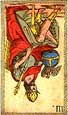
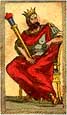
 | The card at the top left represents how you see yourself. The Western Emperor, when reversed: Weakness in character leading to tyranny and abuse of worldly power. Loss of confidence and ambition, coupled with the cold execution of the unthinkable. The inability to carry out plans or command respect. Being unreasonable and prone to fits of rage. A deceiver or demagogue. |
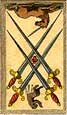
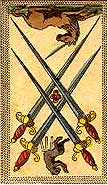 | The card at the top right represents how you see your partner. Four of Swords (Truce), when reversed: Restlessness and mental disharmony. Deserting a struggle in progress. A temporary retreat from stress that turns into a permanent rout. A lack of vigilance that could lead to disaster. |
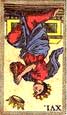
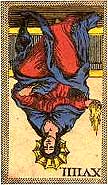 | The card in the center left represents how you feel about your partner. Charity, when reversed: Kind and charitable acts motivated by vanity or desire for personal gain. Using a position of good fortune to make someone less fortunate dependent on you. Ill-conceived good intentions that make matters worse. A second chance with an expectation of failure. |
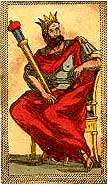 | The card in the center right represents what stands between you and your partner. King of Wands: The essence of fire behaving as air, such as lightning: A great and daring leader who inspires others to rise to challenges alongside him. An artist who can take hold of an idea and make it a reality through bold action. One who is forceful, charismatic, and honest, leading by example, but unafraid to invest authority in others. A dashing and magnetic personality, carrying authority naturally, and striking at the world with swiftness and grace. |
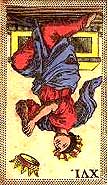 | The card in the lower left represents how your partner sees you. Hope, when reversed: Refusal to withdraw from an untenable position. Prideful stubbornness in the face of certain defeat. Waiting idly for miracles instead of working to create one. A slow and inevitable grind towards failure. |
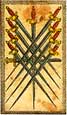
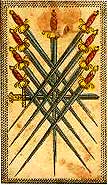 | The card in the lower right represents what your partner feels about you. Ten of Swords (Ruin): Crushing defeat brought about by idle intellectualism divorced from reality. Sadness and desolation in the aftermath of a catastrophic and total collapse. A decisive conclusion brought about through the swift and merciless application of overwhelming force. |
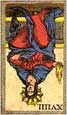
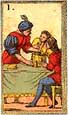
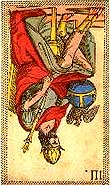
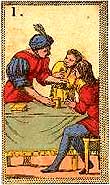 | The card in the center represents the present status or challenge of the relationship. The Magician: Mastery over word, mind, and matter. The ability to turn ideas into actions, handle problems, and control one's life. The initiation of new projects, great works, or a new way of life. Eloquent and moving communication. Arcane and eldritch technologies. |