| The Fourfold Vision spread offers a progression of different ways of looking at an object, person, or situation. It is a powerful tool for gaining deeper insight into the specific subjects of other readings. The Rider Waite Tarot is the most widely recognized Tarot deck, and the first deck published in the 20th century. It was created by members of the Hermetic Order of the Golden Dawn, and is especially suited to questions of a mystical nature. If you would like your own copy of the Rider Waite Tarot, you can buy it now! |
 | The card on the far right represents the object being viewed, be it an idea, relationship, or the self. The Magician, when reversed: Trickery, demagoguery, and artful deceptions. The use of knowledge and skill for selfish gain or destructive purposes. The abuse of technology. Incompetence and uncertainty. A lack of will power. A fatal flaw in a great work. |
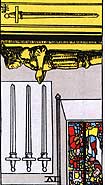 | The card second from the right represents the physical vision: how the object is seen at a base or mechanical level. Four of Swords (Truce), when reversed: Restlessness and mental disharmony. Deserting a struggle in progress. A temporary retreat from stress that turns into a permanent rout. A lack of vigilance that could lead to disaster. |
 | The card in the middle represents the mental vision: the object personified and seen through a humanized perspective. Three of Wands (Virtue), when reversed: Pride and arrogance. Convincing oneself that the ends justify the means. A great act of betrayal set in motion. Sinking to the level of an opponent. The vain quest for glory and a personal spotlight. Charity or friendship offered with intent of material gain. |
 | The card second from the left represents the emotional vision: how passions and values are creatively stimulated by the mental vision. Six of Swords (Science), when reversed: Conceit and intellectual pride. Being stuck in a problem which has no apparent solution. Frustration and anxiety that are left unsettled. Travel and exploration are delayed. |
 | The card on the far left represents the fourfold or mystical vision: still viewing through the previous three, we now add a spiritual element, revealing unseen aspects of the object. The Hierophant, when reversed: Authoritarianism. Inflexible and dogmatic thinking. A calcified old regime. Bad or incompetent advice. Inability to hear a higher or inner voice, or pretending to hear it for personal gain. |