Today's Tarot for William Gibson
| The Cross and Triangle spread is a powerful means of understanding complex situations, developed by the Hermetic Order of the Golden Dawn. This spread is rich in occult and mystical symbolism, and one of our favorites here at Facade. The Golden Tarot is a modern celebration of late medieval artwork. This deck is the choice of scholars, for it evokes images of elegance amid barbarism, and the light of virtue in dark times. If you would like your own copy of the Golden Tarot, you can buy it now! |
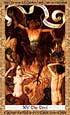
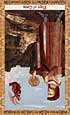
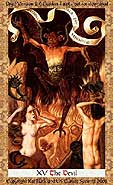 | The first card, the significator, is placed in the center of the cross. This card represents the prime energy manifest in your life. The Devil: Being seduced by the material world and physical pleasures. Lust for and obsession with money and power. Living in fear, domination and bondage. Being caged by an overabundance of luxury. Discretion should be used in personal and business matters. |
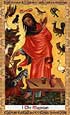
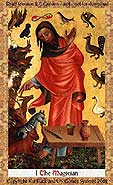 | The second card, placed above the significator, represents Air. It describes your spirit, process of thought, and the influence of reason. The Magician: Mastery over word, mind, and matter. The ability to turn ideas into actions, handle problems, and control one's life. The initiation of new projects, great works, or a new way of life. Eloquent and moving communication. Arcane and eldritch technologies. |
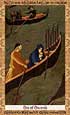
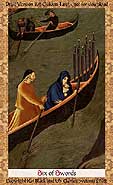 | The third card, placed to the right of the significator, represents Fire. It describes your motivations, creative energies, and the influence of passion. Six of Swords (Science): Trusting in intelligence and intuition and setting off into the unknown. Leaving an untenable situation and charting a new course. Passage from difficulty and progress towards a solution. The road to recovery. Travel and exploration. |
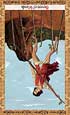
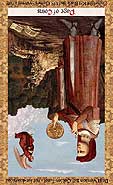 | The fourth card, placed below the significator, represents Water. It describes your emotions, meditations, and the influence of love. Page of Coins, when reversed: The dark essence of earth, such as a chasm: Unfavorable news about business, finance, or the physical world. One who delights in all forms of luxury and physical excess, leaving practical matters unattended. Irrationality and failure to recognize obvious facts, coupled with a poor work ethic. Wastefulness, lack of focus, and loss. May portend the loss of a job or promotion. |
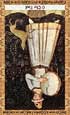
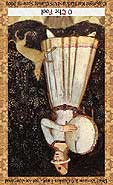 | The fifth card, placed to the left of the significator represents Earth. It describes your physical presence, position in life, and the influence of the material world. The Fool, when reversed: Apathy, negligence, and dangerous carelessness. Unquenchable wanderlust. Obsession with someone or something. Losing all sense of proportion. Foolhardy adventuring and lack of interest in critical matters. Immature or unrealistic ideals. Strange impulses and desires coming from unexpected sources. Vanity, delirium, folly, and oblivion. |
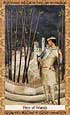
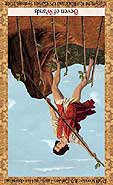 | At this point the cross is complete and the triangle is formed. The sixth card, placed on the bottom left of the triangle represents one of two opposing forces. Seven of Wands (Valor), when reversed: Failure to stand up for your beliefs in the face of a hostile majority. A self-fulfilling fear of failure or embarrassment. Great challenges met with cowardice. Quarrels, perplexity, and indecision at a crucial moment. |
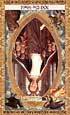
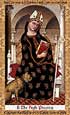
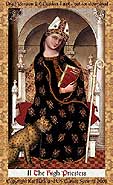 | The seventh card, placed on the bottom right of the triangle represents the force that opposes the bottom left card. These forces may be external, but they are frequently one's own inner archetypes in conflict. The High Priestess: A pure, exalted and gracious influence. Education, knowledge, wisdom, and esoteric teachings. The forces of nature. Intuition, foresight, and spiritual revelation of the most mysterious and arcane sort. |
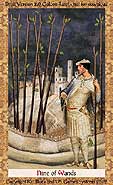 | The eighth card, the reconciler, is placed below the cross in the third vertex of the triangle. This is the force that will resolve the conflict between the bottom left and bottom right cards. By meditating on this force and bringing more of it into your life, you can bring the matter at hand to a swifter conclusion than would naturally occur. Nine of Wands (Strength): A pause in the current struggle to ready oneself. Preparation to meet the final conclusive onslaught. Forces assembled in anticipation of trials and tribulations. The steeling of the will to stand or fall. A line drawn in the sand. |
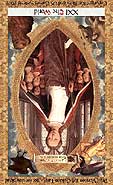 | The ninth and final card, placed in the center bottom of the triangle, represents the final outcome unless you change course. The World, when reversed: Incompleteness and shoddy design. A great work betrayed. Insecurity, fear of change, and the failure to reach goals. Regret and disappointment. |
|
|